"The word is the making of the world." - Wallace Stevens
Showing posts with label Mind Voyages. Show all posts

Sunday, January 16, 2011

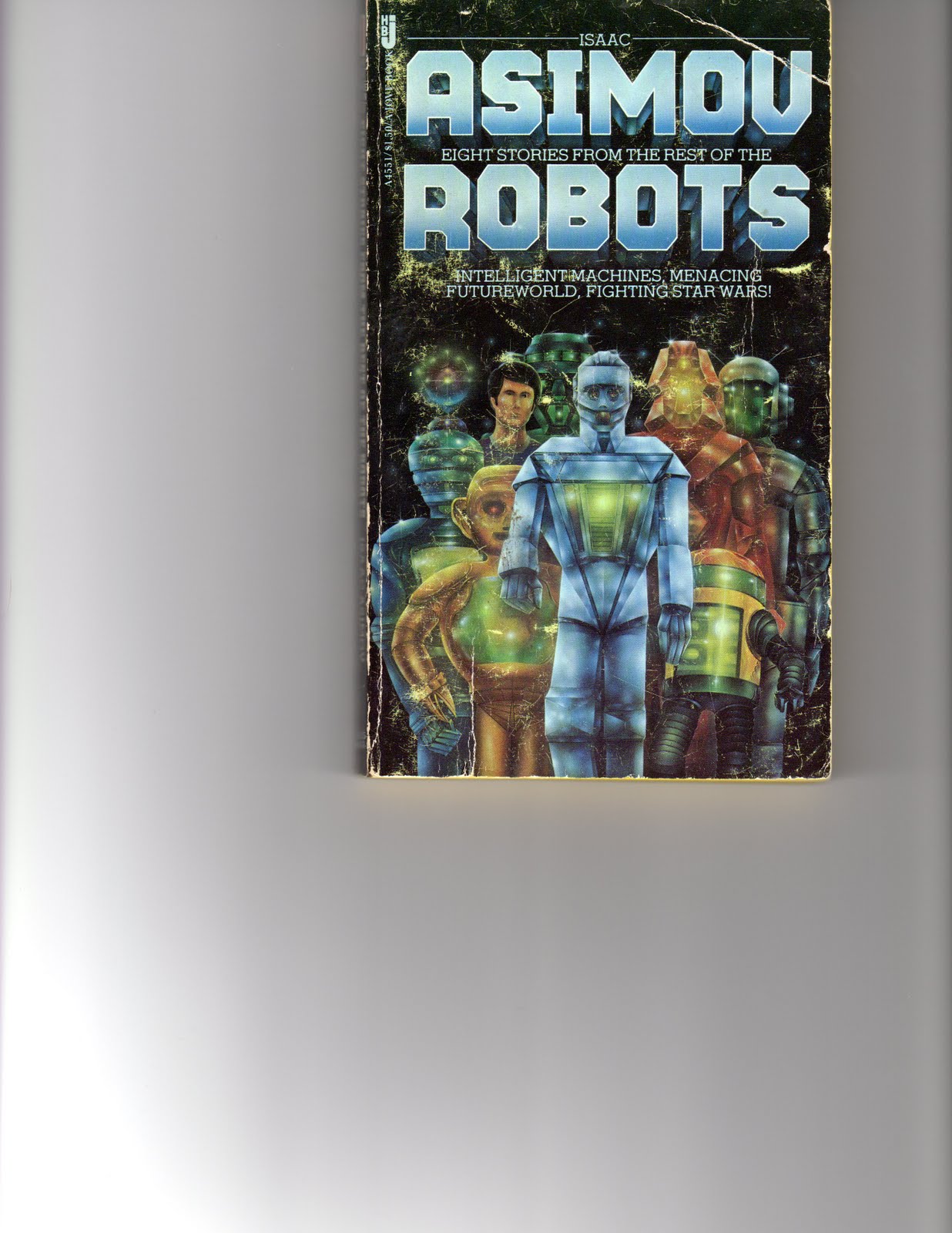
Eight Stories from the Rest of the Robots - Isaac Asimov


Couldn't find a picture of this edition's cover on the net. And for some reason that I haven't been able to fix, this is the best I can do with my scanner right now. Grrr.

This collection of robot stories from Asimov was really enjoyable and scored me a trip to Uranus on the Mind Voyages challenge when I finished it early last month. The stories are:

Robot AL-76 Goes Astray
First Law
Victory Unintentional
Let's Get Together
Satisfaction Guaranteed
Risk
Lenny
Galley Slave

This was the first I'd heard of Dr. Susan Calvin the roboticist, who I'm still not sure I liked or not. I did like how Asimov's style questions the boundaries of human and robot; you get a good look at his robots' "human" sides.

I think my favorite short of this collection was Victory Unintentional. A group of robots are sent to Jupiter to observe the Jovians, who are hostile to humankind but so far not technologically advanced enough to threaten them. And the robots have distinctive personalities and qualities that help tell the story. It's simple, but effective story telling: the Jovians observe the robots performing any number of feats that an actual human would be incapable of and are duly impressed, thinking that they are observing examples of human capabilities. It's not until the end of the story that the robots understand they have probably quelled interstellar war, simply by being themselves.

Very entertaining and insightful writing. Asimov fan? Add this to your list of must reads.

Sunday, December 26, 2010

Shadow of the Hegemon - Orson Scott Card


I swiped this copy from my brother when I was visiting in Ohio back in the middle of November. I enjoyed this read, but it wasn't without its flaws. The story stumbled a bit with keeping my attention; sometimes what kept me reading was the fact that I'd read the previous Ender books and was already caught up in some of the characters. I wouldn't recommend this being the first Ender book you read, it will be hard to understand or stick with. The story follows the events that take place after Ender's War, after the Battle School students return to earth and world war seems imminent. The character development is impressive, Bean and Petra especially. And the ending is satisfying. If you are a fan of Card and the Ender stories, you will enjoy this book.

Monday, December 13, 2010

Children of the Mind - Orson Scott Card


This is the fourth and last book of the Ender series. Hurray, I've read them all! And although I enjoyed this story a lot, I would probably give it fourth place out of the four. Why?-It was as enjoyable as it was unsatisfying.

A quick premise of the plot: the Starways Congress has decided to destroy Lusitania and all the beings who live on it, human, pequinino, and bugger because the descolada virus could potentially get out and wreak havoc. Good old government. Only Jane, the evolved being who lives in the ansible Net, can save everyone but the Congress is also deliberately shutting down the Net and Jane is losing the ability to move ships outside the known universe and back. Soon she won't be able to help her friends in their mission to find the origins of the descolada virus OR save her life. And while being moved in this way by Jane, Ender's personality/soul/aiua is split into three different beings, himself and his "children of the mind".

Typical of Card's writing, there are multiple interconnected story lines going on, involving a diverse group of people from different species and cultures. While there was a lot of dialogue involving philosophical ideas that I found interesting, not all of it was necessary to get the point across which made it tedious. And there were other characters who interested me, but you don't really get a chance to get all that attached to them. I liked Wang-mu to start off with, but I thought her relationship with Peter was unrealistic and it ruined her for me. My least favorite character was probably Ender's wife, Novinha. Since she was introduced in the story, she's been in dire need of a sharp kick in the butt. Granted, her life was full of tragedies, but in Novinha's case, her personality makes a life long tragedy out of everything. She just seems like such a completely unlikable drama queen, the more so because she's so determined that what she decides is right, that's she's acting out of someone's best interest so the ends justify the means. I have zero patience for this thinking in real and fictional people! You have to wonder what someone like Ender sees in her. She does do the right thing at the end of the story, but she doesn't get there by herself. Valentine has to coach her not to be a selfish cow. Ugh, Novinha.

Card originally planned Xenocide and Children of the Mind to be one cohesive story. And I think he should have gone that route. But despite some lumps, this story is still enjoyable and brings up all kinds of thought provoking ideas, i.e. with the "birth" of the new Peter and Valentine added to the existence of Jane, Card asks the question, do we have to have a physical base to have a soul? And which came first?

Ender's Game, Speaker for the Dead, and Xenocide are well worth reading if you haven't already and I highly recommend them. And while I'm glad I read Children of the Mind, I can't say I wasn't disappointed overall. The ending was left open enough, you have to wonder if OSC is planning to do something else with these characters. After reading this novel though, I hope he just leaves them where he left them.

Wednesday, August 4, 2010

The Gripping Hand - Larry Niven & Jerry Pournelle


"Humanity's finest minds have spent the past quarter century analyzing and agonizing over the deadly threat posed by the only aliens mankind has ever encountered- a race divided into distinct biological forms, each serving a different function. Master. Mediator. Engineer. Warrior. Each supremely adapted to its task, yet doomed by millions of years of evolution to an inescapable fate. For the Moties must breed- or die. And the single wall standing between them and the galaxy beyond is beginning to crumble...." -excerpt from the dust jacket

Another trip to Jupiter for the Mind Voyages challenge. Last week I finished The Gripping Hand, the sequel to The Mote in God's Eye and a book that was apparently eighteen years in the making. It takes place 25 years after mankind's first encounter with the alien species known as the "Moties". There is a wormhole that allows ships to pass from the Mote system into normal space, protected by a military blockade to prevent the Moties from leaving their solar system. The Moties two biggest problems are that they are in a state of constant population explosion and exhausted resources. A new Alderson Point (wormhole) is expected to materialize, although exactly where and when is open to interpretation. And so the plot begins, with new and returning characters.

There were elements to the story that left me disappointed, in both the book and the authors. One was a saying that was frequently used by male characters to express exasperation or surprise that left me kind of angry and to be honest...well I can't honestly say why the phrase "rape my lizard" bothered me, but it did. I'll just leave it at that. And there were characters (Jennifer and Terry) whose fate was never concluded to the reader, and I was looking forward to that part. And lastly, as a woman reading this novel, there was a lot of blatant sexism. I was really starting to like the character Commander Ruth Cohen, who isn't heard from again after Renner's had his fling and leaves her behind. The only female characters that have any real bearing on this story are an overly sexualized aggressive reporter who (surprise!) uses sex to get information and a just turned legal age "I have authority issues" aristocrat who bats her eyes at her sometimes boyfriend to get him to fly her into the Mote in his racing space yacht. The MD to Horace Bury turns out to be an assassin/martial artist/concubine, and her job is to be whichever her master needs when he wants it. It's like the authors are working out sexual fantasies through their characters. The pilot turned Captain is a man, the Imperial Trader with Motie experience is a 116 yr. old man, the scientific advisor/astrophysicist is a man. Although Glenda Ruth Blaine, the young aristocrat, does have the important job of carrying a special cargo that may help the Moties to change their fate. But once this is done, her importance in the story fades out too.

There were elements to the story that I enjoyed too, such as the authors making use of different aspects of human cultures to explain how the Moties dealt with their situation and communicated with humanity. The phrase "on the gripping hand", as in "on the other hand", was picked up by human people from the Moties, since most Motie biological forms have two slender six fingered right hands, and one big muscular left hand. The human characters are also picking up Motie body language, learning to shrug without moving their shoulders, for instance. There are a lot of scientific and mathematical explanations of space travel and space warfare too. I think Niven and Pournelle have some sort of obsession with coffee too. Every chapter mentions coffee! Drinking it, trading it, producing it. If they were trying to tell me something while referencing coffee, I couldn't pick it up. Unless it was that their characters are caffeine junkies?

I would definitely recommend reading The Mote in God's Eye first. And I definitely enjoyed that novel more. This isn't a sequel that can be easily enjoyed or understood without understanding what happened 25 years earlier in the storyline. But honestly, if you don't get around to The Gripping Hand for a while, don't sweat it. Entertaining, sometimes. Disappointing, YES!
Friday, July 2, 2010

The Face of the Waters - Robert Silverberg


I found a copy of this novel on my mom's bookshelf while I was visiting Ohio last month, and thought it sounded like a great Jupiter Voyage. I'm also including this one in the Speculative Fiction Challenge. (The only other Silverberg I've ever read is The Ugly Little Boy, originally a sci-fi short by Asimov, and I really enjoyed it.)

It was interesting to go from reading about the water world of Le Guin's Earthsea to Silverberg's planet, Hydros. Like Le Guin's world, Hydros has not yet been fully explored by the human population and communication between islands is primitive. Except in Silverberg's story, the humans are not originally native to the planet. Earth was destroyed generations before. Hydros was originally used as a penal colony and there is no way to leave the planet once you arrive; the native race called the Gillies or Dwellers have forbidden the building of spaceports, and the "islands" that the humans live on with the Gillies are artificial and constructed of organic materials. Having been warned once already by the native race not to abuse the natural environment, one island of humans is banished for killing local wildlife (sentient creatures called "divers"), and given one month to pack up and get out. The long and short of the plot is that they have nowhere to go but through the Empty Sea and into uncharted territory to face the Face. I think Silverberg is excellent at bringing out his characters' attributes and flaws, making them very relatable. The main character, Valben Lawler, is struggling to define his humanity as a human who was born on Hydros and will never leave it, and dreams about Earth and will never see it. When you're putting yourself in his shoes as you read this story, you can sympathize with him every step of the way.

Sunday, June 27, 2010

The Earthsea Trilogy - Ursula K. Le Guin


Before Harry Potter and Hogwarts, there was Ged and Roke Island. I read this for a Neptune Voyage on the Mind Voyages challenge, and am also counting this as fantasy fiction for the Speculative Fiction Challenge. The Earthsea Trilogy is made up of the three small novels: A Wizard of Earthsea, The Tombs of Atuan, and The Farthest Shore. I got very attached to the recurring character, Ged/Sparrowhawk, who travels the world in his boat Lookfar. The three novels are three major quests that Ged, a mage, completes at different stages of his life, while helping others and facing his fears. The planet is Earthsea, a world made up of islands, mountains, sea voyages, magic, dragons, and various human cultures. I love this author. She is a master of world building. In the past year, I've reread The Left Hand of Darkness, another great read of hers. I give each book five out of five stars.

Saturday, May 29, 2010

Mind Voyages

How can I be my mother's child and NOT sign up for this challenge? I've been looking for an excuse to reread The Mote in God's Eye. And Babel-17. And Ender's Game. And Dune. And Do Androids Dream of Electric Sheep? a.k.a. Blade Runner. And heck, maybe I'll even try something new. Plus, some of these can double up w/ my speculative fiction challenge. Yay!